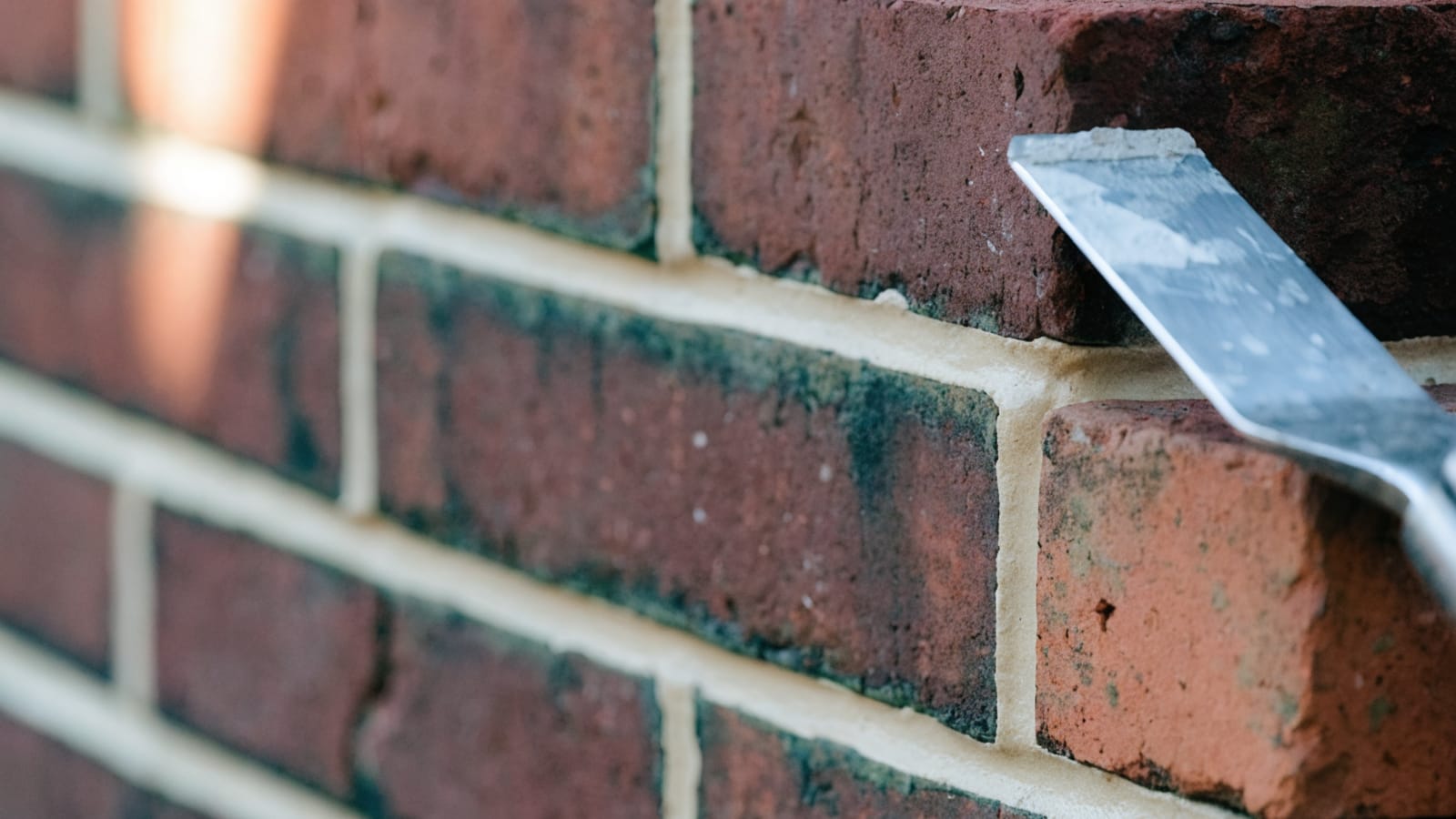
Mortar joints are the sacrificial part of masonry, and that is by design: the joint weathers so the brick does not. On the Front Range the weathering happens on an accelerated schedule, and after enough freeze-thaw winters the joints go soft, crack and recede. Tuckpointing, grinding out the failed mortar and packing in new, is how a brick chimney or wall gets its next several decades without losing a single brick.
What repointing actually involves
The failed mortar is ground or raked out to proper depth, the joints are cleaned and dampened, and fresh mortar goes in by hand in lifts, then gets struck to match the original joint profile. Done correctly it is quiet, dustless work with containment, and the wall afterward reads as itself, only crisp. Done badly, smeared over old joints without grinding, it is cosmetic caulk that fails in a couple of seasons and makes the eventual honest repair harder. We only do it the first way.
The mortar match is the craft
Color matching is what people notice; hardness matching is what matters. Much of Boulder's older masonry, the Victorians around Mapleton Hill, the early blocks near the CU campus, was laid with lime-rich mortar that is softer than modern cement mix. Repoint those joints with hard modern mortar and the physics reverses: the joint stops sacrificing itself and the century-old brick starts to, spalling faces with every freeze. We match the mortar to the wall it is joining, in composition, color and joint tooling, so the repair behaves like the original and looks like it too.
When to repoint
Run a key across a joint: if mortar powders out, or you can see receded, cracked or missing sections, the wall is asking. Catching it early means repointing the weathered faces only, usually the west and south ones that take the sun and the storms. Waiting means water gets behind the brick, and then the conversation involves rebuilding rather than repointing. The look, as always with us, costs nothing.
Tuckpointing FAQ
How long does repointing last in Colorado?
With a proper grind-out and a matched mortar, decades; it is the same lifespan logic as the original construction. The failed version to avoid is surface smearing, which peels within a few winters here.
Can you repoint just the chimney, or the whole wall?
Either. Chimneys weather fastest because they take weather from all four sides plus the flue's own heat cycles, so they are the most common repoint we do, but the same craft applies to walls, foundations and retaining masonry.
Will the new mortar match the old color?
We blend to match cured color, not wet color, and we sample before committing to the wall. On historic masonry we would rather spend an extra hour on the match than leave a repair you can read from the street.